January can feel heavy, flat, or quietly underwhelming.
Whether you celebrated Christmas, spent time socialising, or experienced a very different kind of break, most of us move through January having stepped out of our usual routines. Alongside that, there is often an unspoken expectation to feel motivated, energised, and ready to begin again.
However, that isn’t usually how January feels. Especially if you’ve had a busy break, or a break where more rest was needed but not truly available, the return to “normal life” can feel jarring rather than inspiring.
So if you’re feeling slow, flat, resistant, or quietly overwhelmed, there is nothing wrong with that. There is a nervous system story here. Our biology doesn’t work according to calendars. And just because the year has changed doesn’t mean your nervous system will automatically conform.
⸻
Winter rhythms and the nervous system
From a nervous system perspective, January is often a time of recalibration rather than renewal.
Low energy, reduced motivation, and a desire to withdraw are not signs of failure. They are signs of a system settling after intensity and responding to winter itself — colder temperatures, darker days, and lower light levels. Many people feel this more strongly if they are neurodivergent, sensitive, or already carrying a lot.
Your body may be asking for:
• less pressure
• fewer demands
• steadier, more predictable rhythms
• more warmth, rest, and gentleness
Winter was never meant to be a sprint. It is a time to recalibrate, to move slowly, and to find a pace that feels right for your body rather than one imposed by expectation.
⸻
Rethinking how we begin
Traditional New Year’s resolutions often carry a black-and-white energy: perfection or failure, success or disappointment. For many people, this quickly becomes self-criticism rather than self-support. Goals turn into measuring sticks, and January becomes a test rather than a transition.
January isn’t about becoming somebody new. It’s about becoming more aligned with the version of yourself you would like to care for.
Instead of asking:
• What have I achieved?
• How productive have I been?
• Have I hit my goals?
A gentler reframe might sound like:
• What would support me right now?
• What’s one small thing I can do today?
• What have I done well, even quietly?
This shifts the focus from pressure to presence.
⸻
Gentle promises instead of pressure
A softer way to move through January is through promises, not punishments.
Promises that are:
• taken day by day
• rooted in compassion rather than control
• flexible enough to meet you as you are
This might look like:
• checking in with your body once a day
• choosing rest without guilt
• prioritising nervous system care over productivity
• allowing pleasure, ease, and fun to count
It is also important to remember you are bound to find yourself in situations where you can not keep your own promises, in those moments, I invite you to meet yourself with compassion, like you would for a good friend or loved one. Our mind is our personal learning environment, we all respond better to a space that is compassionate, understanding and solution focused. As opposed to critical shame spirals.
⸻
Starting where you are
January doesn’t need an unrealistic or dramatic timeline attached to it.
It can be slow.
It can be uncertain.
It can be quiet.
Starting where you are means letting your body lead rather than pushing against it. It means allowing change to emerge gradually, through small, steady acts of care, rather than forcing transformation before the system is ready.
⸻
A gentle resource
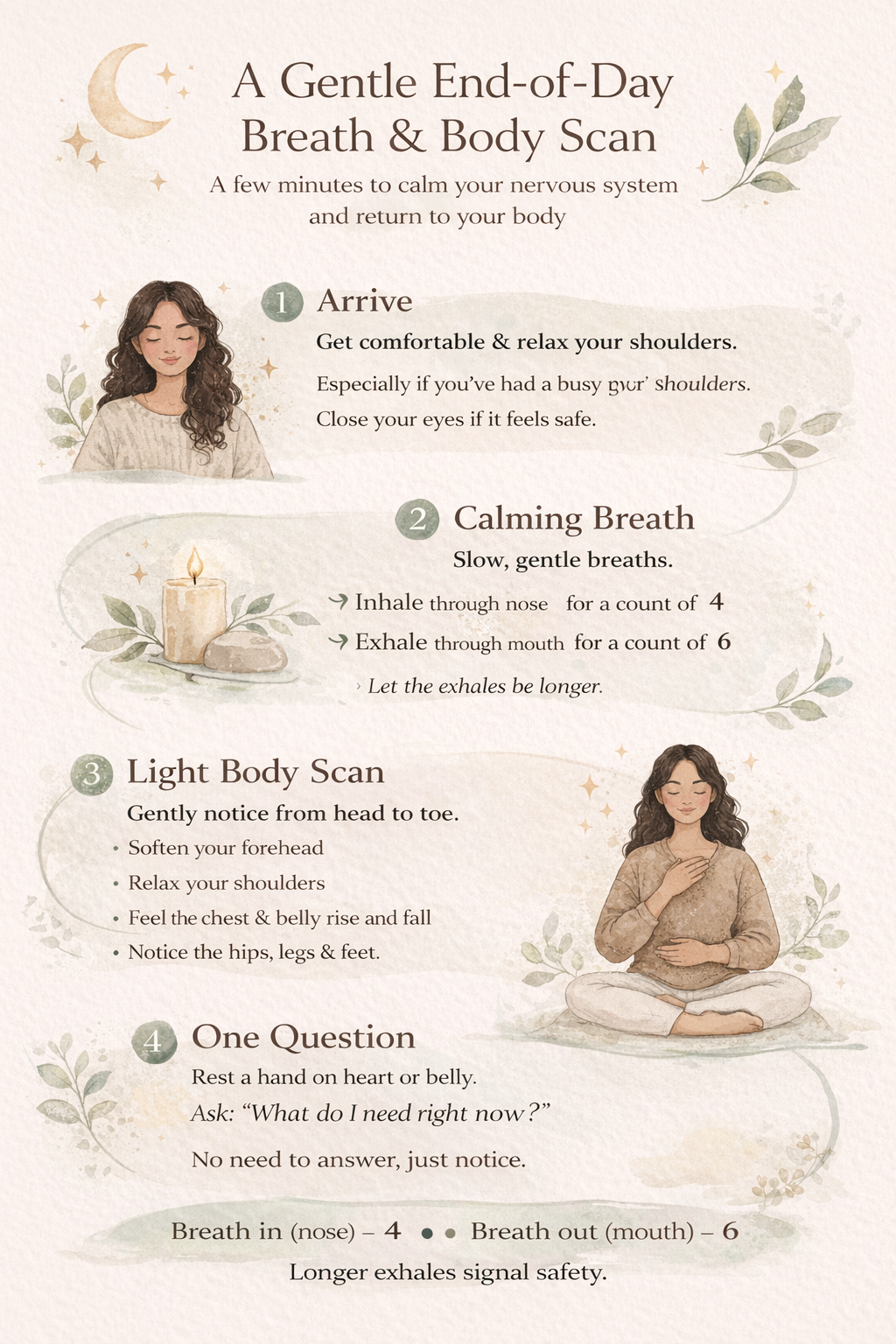
If you’d like to support your nervous system at the end of the day, I’ve created a short, free calming breath and mindfulness practice.
It’s designed to help you:
• settle after a day of stimulation
• reconnect with your body
• gently ask yourself, “What do I need today?”
The practice includes light breathwork and a simple body scan, and can be done seated or lying down, in just a few minutes.
A gentle note:
This practice is offered as a supportive, optional resource. Please listen to your own body and move at a pace that feels safe for you. If you have a history of trauma, panic, breathing-related conditions, or any medical concerns, you may wish to adapt the practice, keep your eyes open, or skip it altogether. This resource is not a substitute for medical or therapeutic care.
Your body is full of wisdom, and healing, growth, and change tend to happen far more gently when we learn to work with it, rather than against it.
With care,
Preeti
The Healing