We use the words knowing and feeling regularly in our everyday lives, but how often do we stop to consider the difference between the two?
We might know something to be true without necessarily feeling it. Equally, we might feel something deeply without having the evidence or logical reasoning to explain why. Sometimes we hold a strong sense of what feels right or meaningful to us, even when we cannot fully articulate where that understanding comes from.
Although knowing and feeling are closely connected, they are not always the same experience.
Intellectualisation and the Body
If you’ve been in therapy or spent time reflecting on your own patterns and experiences, you may have come across the term intellectualisation.
Intellectualisation is a psychological defence mechanism that involves approaching emotionally difficult experiences through reasoning, analysis or explanation, rather than engaging directly with the feelings associated with them.
It can be a way of creating distance from emotions that may feel uncomfortable or overwhelming. While this can serve an important protective function, it can sometimes leave us with a strong intellectual understanding of our experiences without necessarily feeling more connected to them.
For example, we might understand why certain situations make us anxious or recognise how past experiences have shaped our relationships, yet find that this awareness doesn’t always change how we respond.
This is where somatic awareness offers another perspective.
Rather than focusing solely on what we think about an experience, somatic approaches invite us to notice how that experience is felt and expressed through the body. This might include sensations, changes in breathing, muscular tension or the subtle ways we respond to our surroundings.
It isn’t about replacing thinking with feeling, but recognising that both contribute to how we understand and experience ourselves.
Understanding and Experiencing
The relationship between knowing and feeling extends beyond our internal experiences and into how we relate to the world around us.
We can intellectually understand that our relationships, environments and communities influence our wellbeing, but experiencing that connection can be something quite different.
Much of contemporary Western culture places considerable emphasis on individualism, independence and personal development. We are encouraged to understand ourselves, regulate our emotions and take responsibility for our own wellbeing.
While these are valuable capacities, they can sometimes lead us to overlook the extent to which our experiences are shaped through our relationships with others and the wider world.
Our sense of self does not develop in isolation. We are influenced by the people around us, the communities we belong to, the cultures we grow up in and the environments we inhabit.
Perhaps understanding ourselves also involves recognising how deeply connected we are to everything beyond ourselves.
Beyond the Individual
Many Eastern philosophical and spiritual traditions explore the idea of interconnectedness, inviting us to consider our existence as part of a wider whole rather than something entirely separate.
Although these traditions differ in their beliefs and practices, they offer perspectives that can challenge an exclusively individualistic understanding of the self.
For some, this connection might be experienced through spirituality, the universe or a sense of source energy. For others, it may be found through nature, community, shared humanity or simply recognising our place within the natural world.
There isn’t necessarily one way to understand or experience this connection.
What interests me is the distinction between intellectually recognising that we are part of something larger and actually feeling that sense of connection.
We might understand our dependence on the natural world, for example, but spending time in nature can offer a different experience of that relationship. Similarly, we may recognise the importance of community without necessarily experiencing a sense of belonging within one.
This brings us back to the relationship between knowing and feeling.
The Experience of Belonging
Belonging is not simply about knowing that we are included, accepted or part of something. It is also about how we experience that connection.
Sometimes belonging is felt through ordinary moments: a conversation in which we feel understood, being around people with whom we can relax, spending time outdoors or participating in something that holds meaning beyond our individual concerns.
From a somatic perspective, these experiences may also be reflected in the body. Perhaps we notice a sense of ease, a softening of tension or a greater capacity to be present.
Of course, our experiences of belonging are influenced by our histories, relationships and circumstances. Connection may feel natural and comforting for some, while for others it can bring up feelings of vulnerability or uncertainty.
Perhaps this is why understanding and experiencing are both important.
We can develop greater self-awareness and intellectual understanding while remaining curious about how we experience ourselves in relation to others and the wider world.
And perhaps wellbeing is not only about becoming more connected to ourselves as individuals, but also recognising our place within something larger.
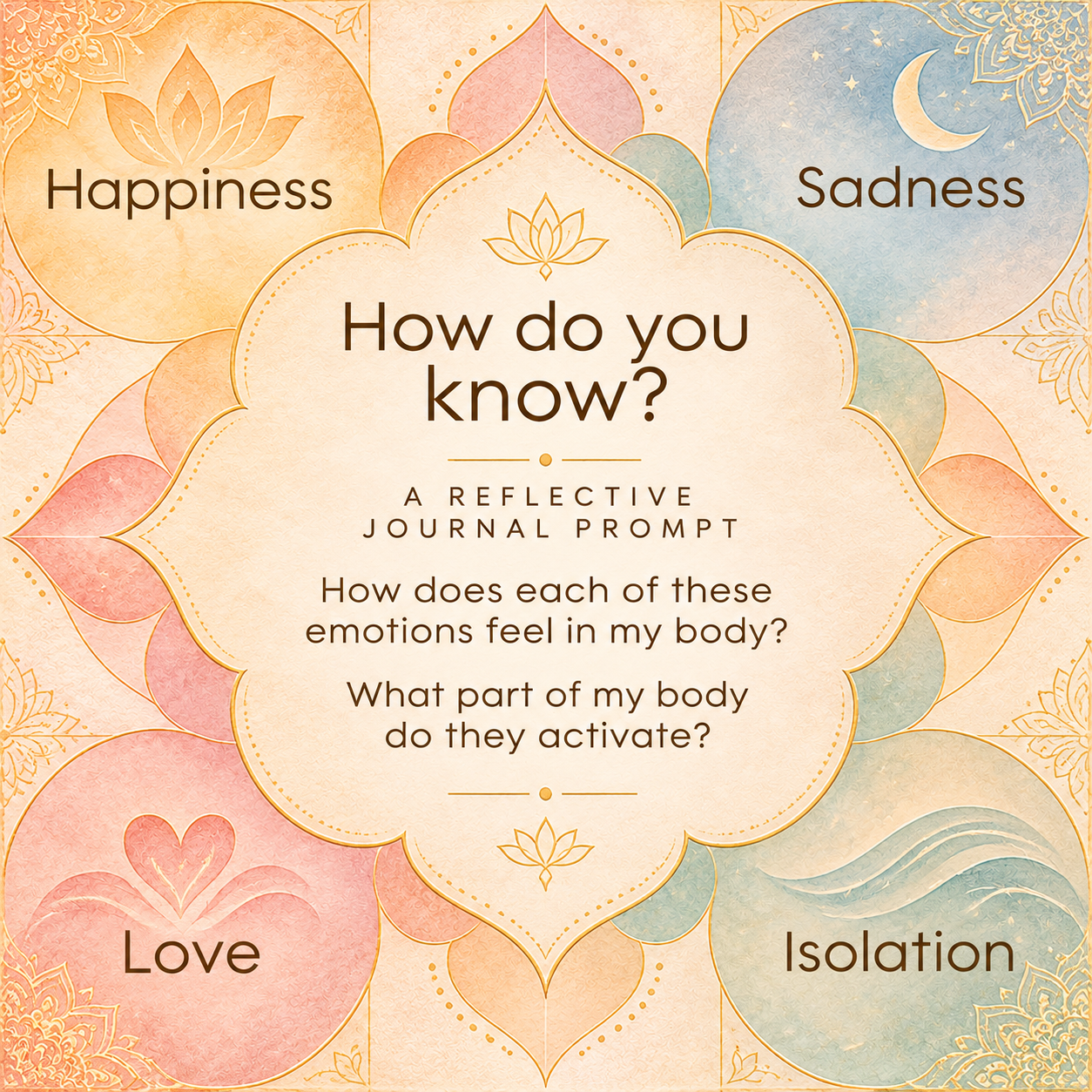
What does it mean to know that we belong, and what does it mean to actually feel it?
An invitation to reflect:
With care
Preeti
The Healing Practice