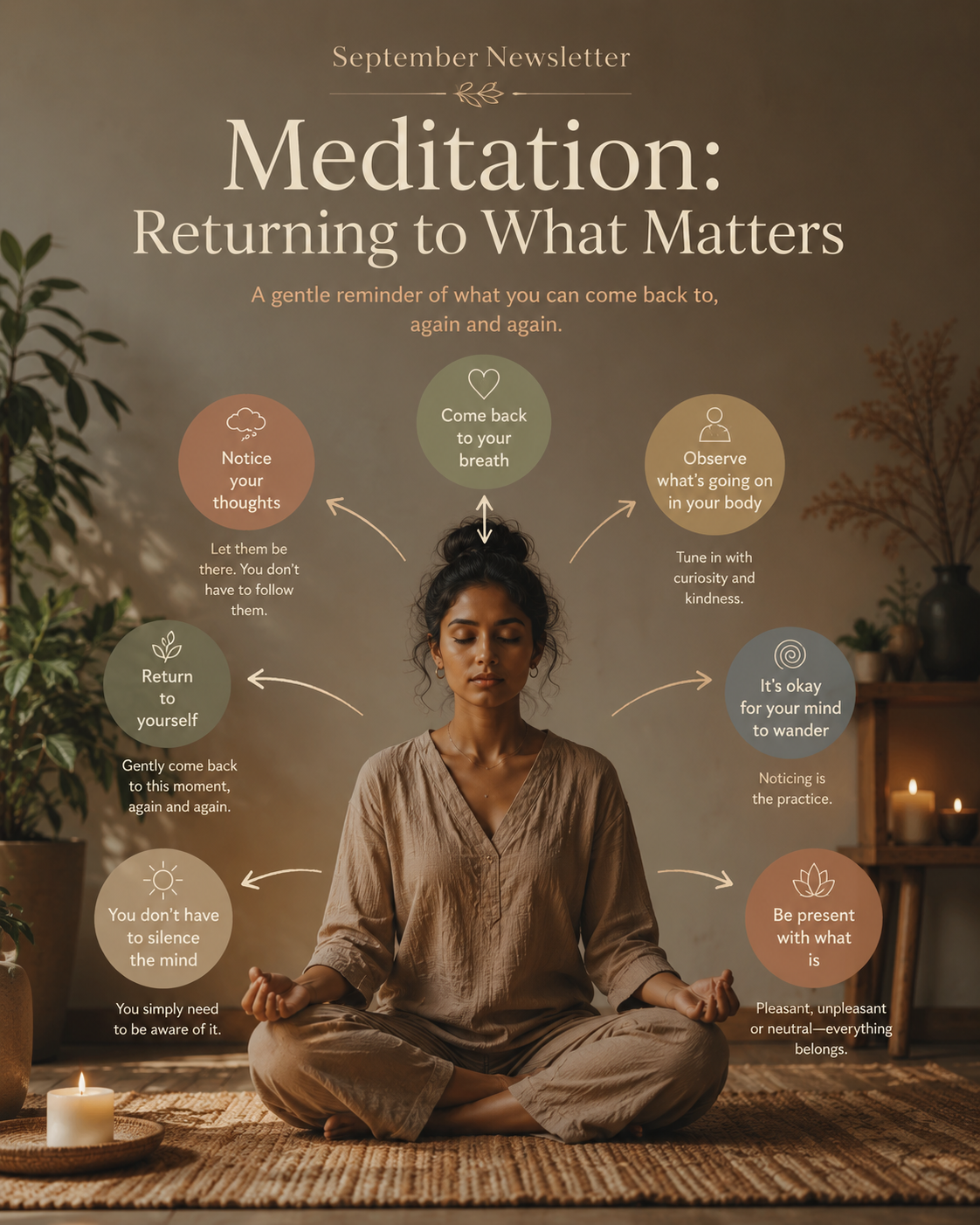
Meditation has become increasingly woven into conversations about mental health, wellbeing and spirituality. We hear about its potential to reduce stress, improve concentration, support emotional regulation and help us feel more present. Meditation apps are readily available, mindfulness is now used within therapeutic settings, and practices that originated within ancient spiritual traditions have found their way into modern everyday life.
Yet despite how familiar the word meditation has become, I wonder how many of us have been left with a rather unhelpful idea of what meditation is supposed to look like.
Perhaps we imagine sitting cross-legged in complete silence, eyes closed, perfectly still, somehow managing to think about absolutely nothing and when that inevitably doesn’t happen, we conclude:
I can’t meditate. My mind is too busy.
I hear this often, and it is one of the reasons I wanted to explore meditation this month. Because meditation does not require us to have a quiet mind. In fact, discovering just how noisy our minds are can be part of the practice.
What Is Meditation?
Meditation has existed in different forms across spiritual and contemplative traditions for thousands of years, so there isn’t one single definition or way of practising it. Some forms use the breath as an anchor, others use mantra, prayer, movement, visualisation, sound or focused attention. Some practices are deeply spiritual, while others are used therapeutically or simply as a way of cultivating greater awareness.
At the heart of many of these practices, however, is something remarkably simple: learning to become aware of our experience rather than being unconsciously carried along by it.
Most of us spend much of our lives inside a continuous stream of thought. We remember what happened yesterday, anticipate what might happen tomorrow, replay conversations, make plans, judge ourselves, solve problems and create entire scenarios that may never happen.
There is nothing inherently wrong with this. Thinking is part of being human.
The difficulty comes when we become so immersed in our thoughts that we no longer recognise them as thoughts. A worry can begin to feel like a certainty. An old belief can feel like a fact. A memory can evoke a physiological response as though the experience were happening again in the present moment.
Meditation gives us an opportunity to notice this.
Meditation Is Not About Stopping Thought
One of the greatest misconceptions about meditation is that the aim is to empty the mind.
If that were the measure of successful meditation, most of us would probably decide we were rather bad at it.
Thoughts will arise during meditation. You might remember something you need from the supermarket. Your mind might return to an uncomfortable conversation. You may start planning the rest of your day. You might notice irritation, boredom, sadness or the sudden desire to check your phone.
None of this means the meditation has gone wrong.
The practice is in recognising:
My mind has wandered.
And then noticing where it has gone.
We don’t have to criticise ourselves for becoming distracted, nor do we need to force the thought away. We can simply become aware of it and gently return our attention to whatever we have chosen as our anchor—the breath, the body, a sound, a mantra, or simply the experience of being present.
In that sense, meditation isn’t necessarily the absence of thought. It is the development of a different relationship with thought.
The Observer
One of the aspects of meditation that I find particularly interesting is this experience of becoming the observer.
Michael Singer explores this beautifully in The Untethered Soul. He draws our attention to the almost constant internal voice that narrates our lives; the voice that comments, worries, judges, remembers, anticipates and has an opinion about almost everything.
We are so accustomed to this internal dialogue that we can easily assume it is us.
Yet meditation presents us with an interesting question. If you can notice yourself thinking, who is noticing the thought?
There is the thought, and there is an awareness of the thought. This doesn’t mean becoming detached from ourselves or suppressing what we feel. Rather, we begin to create a little more space between our awareness and everything passing through it.
From a therapeutic perspective, I think that space can be incredibly valuable.
There is a subtle difference between “I am anxious” and “I notice anxiety arising in me.” There is a difference between “Something terrible is going to happen” and recognising “My mind is imagining that something terrible might happen.”
The experience is still real. The emotion still deserves our attention. But we are no longer quite so fused with the story accompanying it.
Why Meditation Matters
We live in an environment that competes constantly for our attention. Phones, notifications, emails, social media, news, work and the general pace of modern life mean that there are increasingly few moments in which we are simply present without consuming, responding to or thinking about something else.
Our attention is repeatedly being drawn outward, meditation creates an intentional interruption to this pattern.
Research into meditation and mindfulness has associated regular practice with benefits including reduced stress and anxiety, improved attention and emotional regulation, and changes in how we relate to difficult thoughts and emotions. I think its importance extends beyond a list of measurable benefits.
Meditation gives us an opportunity to develop a relationship with our own inner world.
We begin noticing our patterns
The thoughts we repeatedly return to.
The sensations that accompany certain emotions.
The speed at which we move from an experience into a judgement about that experience.
The stories we tell ourselves without even realising we are telling them.
Our awareness creates possibility. We cannot always choose which thoughts appear, what emotions arise or what happens around us, but with practice we may become more able to choose how we respond.
Meditation and the Nervous System
There is another important consideration here, particularly from a trauma-informed perspective.
Meditation is often presented as universally calming but this isn’t everyone’s experience.
For someone whose nervous system has learnt to remain vigilant, sitting completely still, closing the eyes and turning attention inward can sometimes feel uncomfortable rather than peaceful. Becoming aware of bodily sensations may initially increase anxiety, and silence can sometimes make thoughts, memories or sensations feel louder.
This doesn’t mean meditation isn’t available to that person. It means the practice may need to meet them differently.
Meditation can happen with the eyes open. It can involve noticing sounds in the room or feeling the support of the chair beneath you. It can happen while walking, moving, spending time in nature or gently noticing the breath without trying to control it.
There is no prize for sitting perfectly still for twenty minutes.
Sometimes a minute of genuinely present awareness is far more meaningful than twenty minutes spent trying to force ourselves into a state we believe meditation should produce.
Something Deeper
Meditation has therapeutic benefits, but for me there is also something about it that reaches beyond therapy.
When we become quieter, not necessarily because the mind itself has become silent, but because we are no longer following every thought that passes through it, we can sometimes encounter a different quality of awareness.
There may still be thoughts, there may still be sensations, there may still be sounds around us, but we begin to recognise that somewhere amongst all of this activity there is an awareness capable of witnessing it.
Different spiritual traditions have understood and described this in different ways. We might call it consciousness, awareness, presence, the observing self, or something more spiritual.
Perhaps the name matters less than the experience, because underneath the constant movement of thought, there can sometimes be a sense that we are more than the stories our minds continuously tell us.
A Gentle Invitation
If you have ever thought “I can’t meditate because I can’t stop thinking,” perhaps this month I invite you to reconsider what meditation might mean.
You don’t need to empty your mind.
You don’t need complete silence.
You don’t even need to close your eyes.
For a few moments, simply notice.
Notice that you are breathing. Notice the sensations within your body. Notice the sounds around you and when a thought appears, rather than trying to get rid of it, see whether you can recognise:
There is a thought, and perhaps allow it to pass without needing to follow where it wants to take you.
Then another may come and another, that is okay, the practice is not achieving a perfectly quiet mind, the practice is remembering that you are the one who is aware of it.
With care
Preeti
The Healing Practice